
Biochemical changes
782 categorized studies
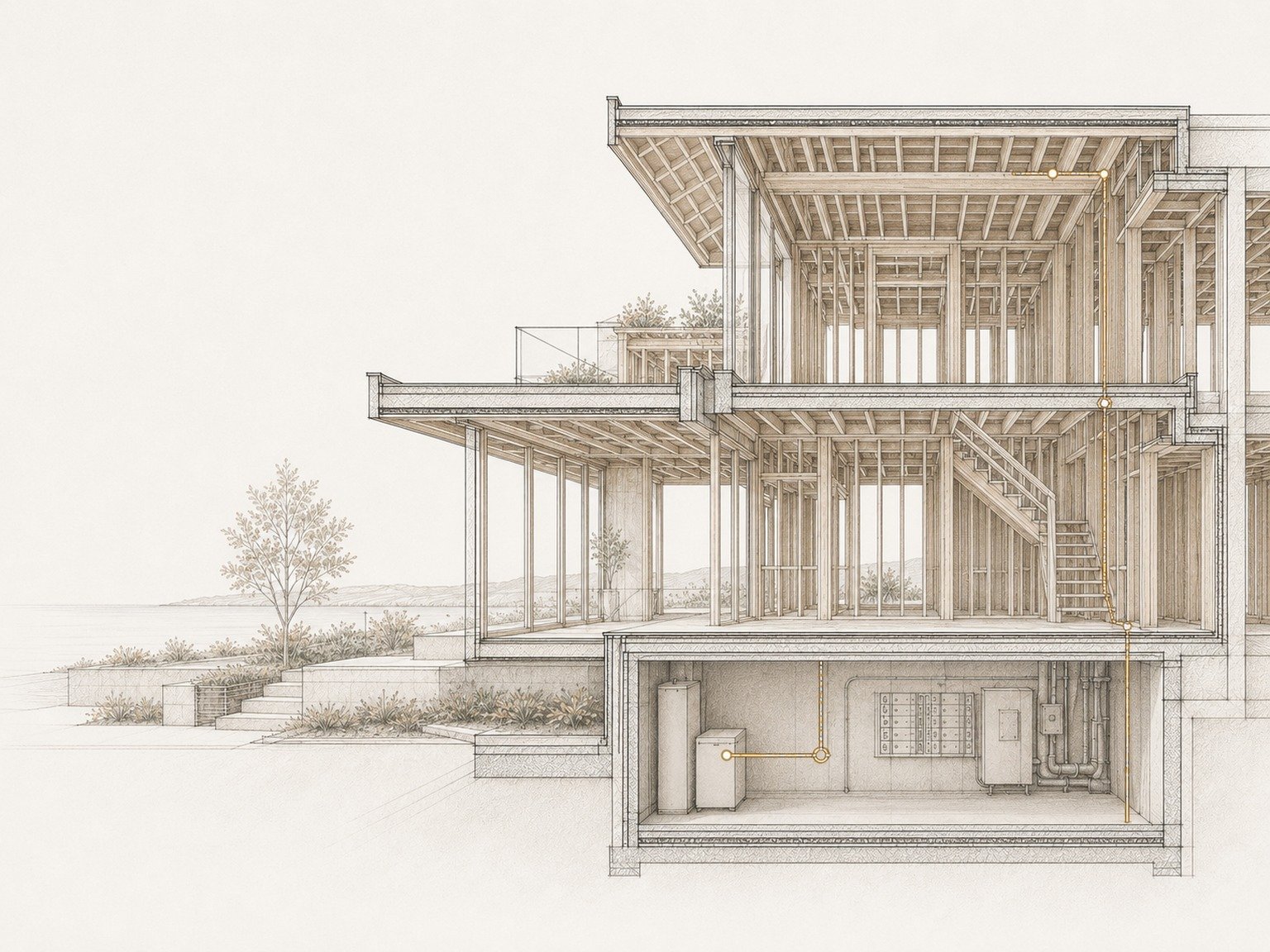
EMF AWARE INFRASTRUCTURE™
Health-informed electrical + technology design brings wiring, lighting, networks, wireless systems, automation, energy systems and connected equipment into the healthy-home conversation.
Healthy-home design already considers air, water, materials, moisture, daylight, acoustics and thermal comfort. Modern homes also depend on an interconnected electrical and technology layer that deserves the same early design intention.
EMF Aware Infrastructure™ is our health-informed practice for intentionally designing and coordinating that layer around the people the building serves.
The practice includes electrical distribution, lighting and controls, wired and wireless networks, automation, connected equipment, energy systems, equipment placement, the electromagnetic environment, verification and long-term adaptability.
BUILT FOR BIOLOGY™
Built for Biology is the public-facing belief behind the work. Technology should support the people who live with it, not simply maximize capability, connectivity and convenience.
The objective is not to remove technology. It is to make electrical and technology systems more intentional, discreet, controllable, adaptable and compatible with how people actually live.
Biology-Informed Design is the practical methodology used within EMF Aware Infrastructure. It adds occupant experience to the technical design brief and guides how systems are placed, connected, controlled, coordinated, verified and operated.

The room, the people who use it and the systems beyond its walls belong in the same design conversation.
A home can be designed for beauty, comfort, efficiency and wellbeing. We consider its architecture, materials, air, water, light and acoustics: everything that shapes how the space looks, feels and performs.
Yet some of the home’s most influential systems are rarely considered through the same human-centred lens. Electrical infrastructure, lighting controls, wireless networks, connected devices and smart-home technology are often designed primarily for function and convenience.
These systems do more than power the home. They help shape the environment within it. EMF Aware brings this overlooked layer into the design process.
When voltage is present and electricity flows through wiring and equipment, electric and magnetic fields exist around them. When Wi-Fi, Bluetooth and other wireless systems communicate, antennas transmit and receive information using radiofrequency electromagnetic fields.
These systems may be invisible, but they are part of the physical environment of the home.
The human body is not electrically inert. Our heartbeat, brain activity, nerve signalling and muscle movement all depend on precisely coordinated electrochemical activity, the same activity medicine observes through ECGs, EEGs and EMGs. Because the body contains water, ions and conductive tissues, it can interact with external electric, magnetic and radiofrequency fields.
At an even more fundamental level, electromagnetism is one of the forces that shapes the physical world. It helps bind electrons to atomic nuclei and plays a central role in the chemical bonds that form molecules and living matter.
Regulatory compliance is essential. Product-based mitigation can be useful in the right circumstances. Measurement after construction can reveal what was built. But none of these, on its own, replaces intentional design.
Health-informed design brings the question upstream, when the project still has options.
The nature of an interaction depends on the type and frequency of the field, its intensity, distance from the source, duration and timing of exposure, system configuration, and the characteristics and position of the person or material involved.
Regulatory organizations such as Health Canada and the World Health Organization assess population-level evidence and establish limits intended to prevent recognized adverse effects. From this perspective, Wi-Fi exposure within Canadian limits has not been shown to harm health.
Health Canada: Wi-Fi and health
World Health Organization: electromagnetic fields
A SELECTION OF THE RESEARCH
A September 13, 2026 snapshot of the ORSAA database on electromagnetic bioeffects. It is a selection of published studies, not a complete list.
782 categorized studies
796 categorized studies
598 categorized studies
447 categorized studies
388 categorized studies
374 categorized studies
Many papers in the database are relevant to low-intensity or non-thermal exposure research: biological changes reported without tissue heating being the primary mechanism. A biological effect is not automatically an adverse health effect. The studies vary in design, exposure conditions, quality, reproducibility and relevance to everyday human exposure. Category totals overlap because a paper may report more than one endpoint.
Regulators, researchers, clinicians, insurers and designers ask different questions about the same environment. Their conclusions should not be treated as interchangeable, but each lens helps explain why thoughtful clients may choose to act with greater intention.
The American Academy of Environmental Medicine and the authors of the EUROPAEM 2016 EMF Guideline recommend considering individual susceptibility, cumulative exposure and the reduction of avoidable exposure as part of a broader environmental-health assessment. These recommendations do not represent the consensus position of Health Canada or the World Health Organization; they demonstrate that clinicians can interpret uncertainty and precaution differently.
The insurance industry offers another perspective, not as a medical authority, but as a specialist in uncertain and potentially long-term liability. Lloyd’s has examined EMF as an emerging risk whose insurance consequences could be significant if causal health relationships were established. Publicly available CFC and Swiss Re policy wordings also show how EMF can be addressed through exclusions or pollution definitions in particular policies.
Insurance exclusions are not evidence that EMF exposure causes illness. They show how underwriters may manage uncertainty, legal exposure and claims that could develop over long periods.
We do not begin with the assumption that every electromagnetic field is dangerous. Nor do we assume that meeting a regulatory limit means there is nothing else worth considering.
We measure where appropriate, identify meaningful sources and distinguish practical improvements from unnecessary interventions. We consider the home as a complete system, not simply as a collection of individual devices.
The objective is not to eliminate electricity, reject wireless technology or create fear around modern life. It is to use technology with greater intention.
Healthy building now considers indoor air and water quality, natural and artificial light, acoustics, thermal comfort, material chemistry and the psychological effects of space. Electrical and technology systems belong in that conversation.
Waiting until a home is complete can make changes more complicated, disruptive and expensive. Considering these systems during planning creates more opportunities to make integrated decisions before wiring, equipment and finishes are fixed in place.
HOW IT ENTERS A PROJECT
The exact scope follows the project. The goal stays the same: make the invisible systems intentional, buildable and understandable.
Occupants, routines, priority rooms, technology expectations and project constraints.
Electrical, lighting, network, smart-home and equipment decisions considered as one system.
Clear direction for architects, engineers, integrators, builders and trades before work is concealed.
Measurement and field review where appropriate to confirm what was actually built and how it operates.
THE DESIGN + BUILD PROCESS
From your first ideas to life in the finished home. Plan early, coordinate through construction, confirm what was built.
THE BETTER FUTURE
A thoughtfully designed home does not need to be less connected, less capable or less intelligent. It can be more intelligently designed.
Its technology can perform quietly in the background. Its electrical infrastructure can support the architecture rather than work against it. Its systems can deliver convenience while considering the people who will live alongside them every day.
A home in which beauty, performance, technology and wellbeing are considered together, from the beginning.
This is what we mean by Built for Biology™: the electrical, lighting, wireless and technology systems of a home designed around the people who live inside it.
DESIGN HEALTH IN FROM THE START
START EARLY
Tell us where the project stands. We’ll identify the right starting point and explain where health-informed systems design can add value.
Discuss your project