
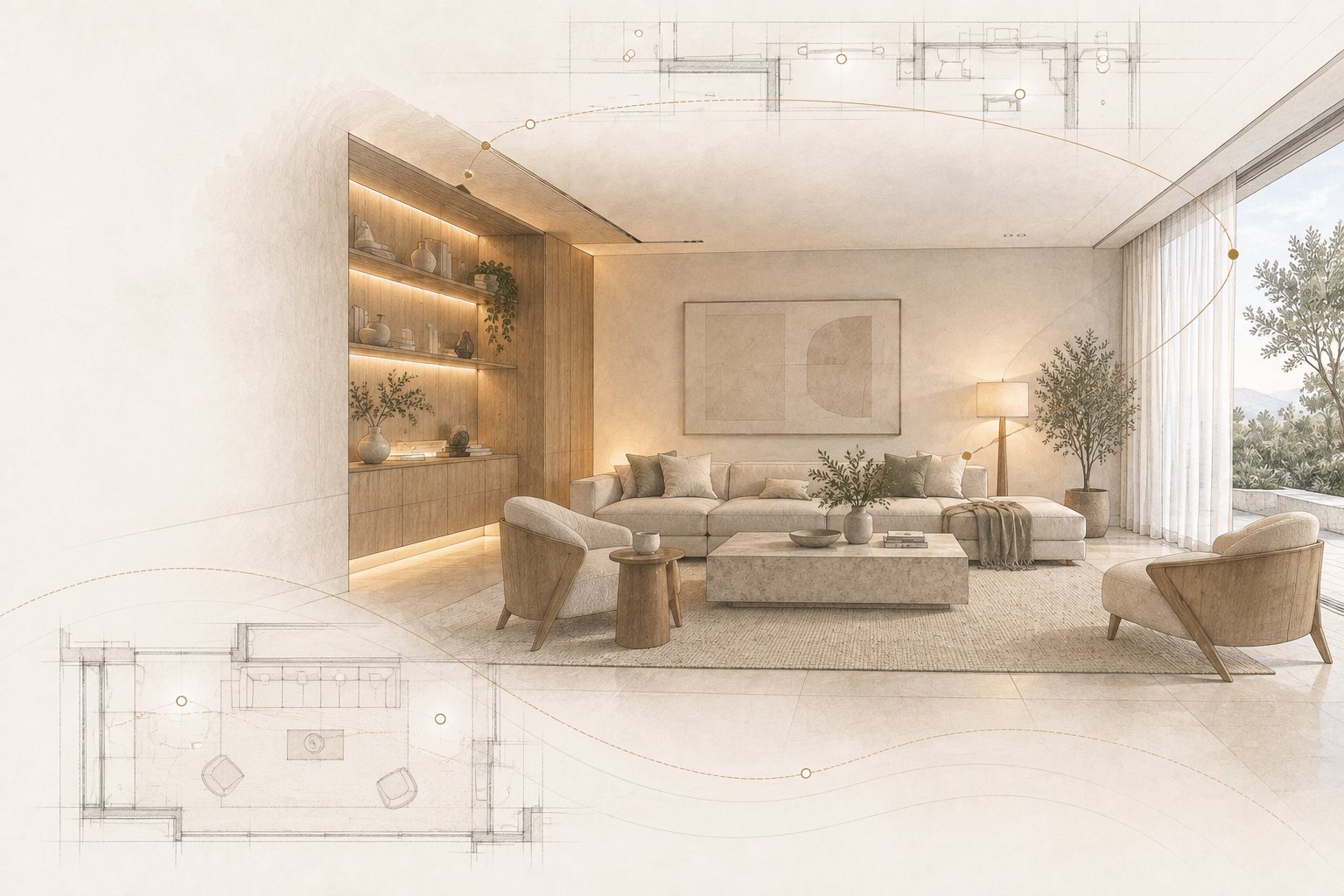
Targets & room hierarchy
Daytime and evening lighting criteria, priority rooms, control philosophy and a practical framework for the trade-offs that come up later.
CIRCADIAN & HEALTHY LIGHTING DESIGN
A lighting scope for owners and project teams who want spectrum, flicker, dimming and controls decided while they are still drawings.
A lighting package is usually judged on appearance, control convenience and energy code compliance. None of those tests ask what the light does to the people under it at ten o'clock at night, whether the fixture flickers, or what the driver and dimmer put back onto the home's wiring.
Those answers are set by ordinary product and circuit decisions: which fixture, which driver, how it dims, where the driver sits, what runs the controls. Once fixtures are purchased and the ceiling is closed, changing them means changing the ceiling.
We aren't the lighting designer. We work alongside the lighting designer, architect and electrical team, bringing health-informed design strategies to the lighting conversation.
Within EMF Aware Infrastructure, circadian lighting sits at the intersection of electrical infrastructure, controls, spectral light and human biology. It is a specialist application of the same broader design practice, not a separate brand.
FROM PRIORITIES TO NIGHT MODE
Daylight and layout come first. Products are qualified before they are bought. Measurement confirms what was actually installed.
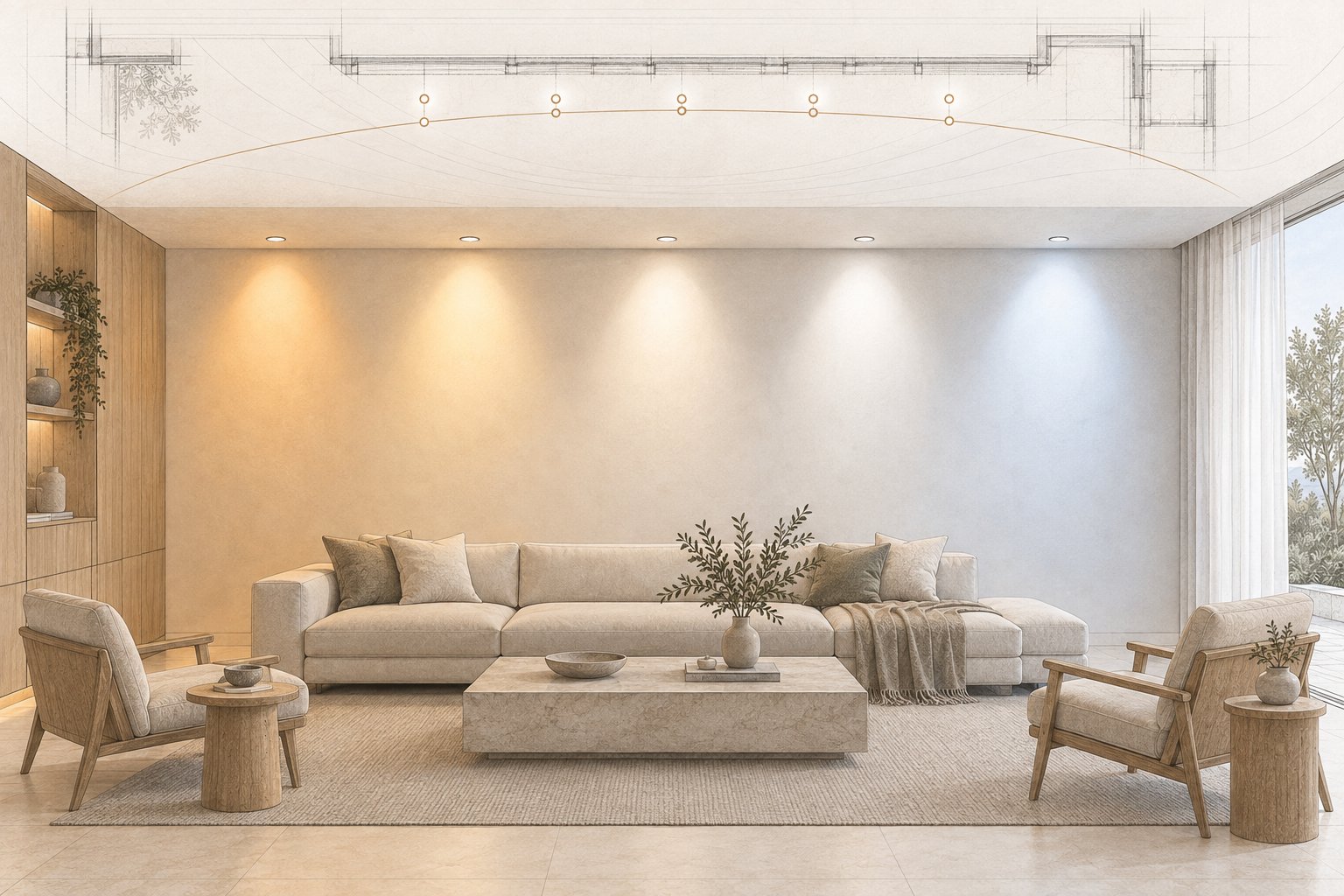
Rooms, routines and evening habits translated into daytime and nighttime lighting targets the team can design against.
Glazing, orientation and room use reviewed first, because the cheapest good light in the project is the light already arriving.
Candidate fixtures, drivers and dimmers tested as a system — spectrum, flicker, noise — before the package is released for purchase.
Control strategy, dimming method, circuit layout, driver locations and a workable night mode, coordinated with the electrical drawings.
Installed lighting measured in day and night conditions, substitutions caught, corrections retested and the result handed over with operating notes.
Daytime and evening lighting criteria, priority rooms, control philosophy and a practical framework for the trade-offs that come up later.
Qualified fixture, driver and dimmer direction, control and circuiting notes, and substitution rules written for designers, engineers and trades.
Sample test data, installed measurements, corrective actions and a short operating guide for how the home is meant to be lit after dark.

Most existing homes can be improved substantially without touching the ceiling. Fixture and lamp replacement, changing the dimming method, relocating drivers and revising the evening scenes account for much of the available gain, and all of it can be prioritized by measurement rather than guesswork.
If the project is already in construction, or the lighting package is already specified, the work narrows to what can still be changed: product substitutions, dimmer selection, circuiting still open at rough-in, and control programming. We will tell you where the remaining leverage is and where it has gone.
No. The lighting designer owns the visual result. We add spectrum, flicker, dimming and electrical-noise criteria to the products and controls being specified, and coordinate with the architect, electrical engineer and trades.
No. Daytime spaces generally want more light, not less, and bright, well-rendered kitchens and work areas are part of the objective. The shift is mostly in what happens in the hours before sleep, and in which products get used everywhere.
Yes. Plan and specification review, product qualification, control strategy and coordination with the design team all work remotely. Site visits are scoped where installed measurement or commissioning adds material value.
No. EMF Aware is independent and does not sell lighting products or take supplier commissions. Recommendations are based on measurement and project fit.
Not necessarily. Dimming method, driver selection, circuiting and control programming often remain open after fixtures are purchased, and testing what you already own tells us which rooms are worth revisiting.
Lighting is one of the larger sources of electrical noise and field exposure in a modern home, and it sits in the same drawings and the same circuits. Treating it as a separate project is usually how it gets handled twice.
ALREADY LIVING IN THE HOME?
START EARLY
Tell us where the project stands and what the lighting package looks like. We will tell you plainly what is still worth changing.
Discuss your project