
JournalNIGHT MODE
Designing the Bedroom for Night Mode
A modern home knows how to wake up. Fewer of them know how to become quiet.
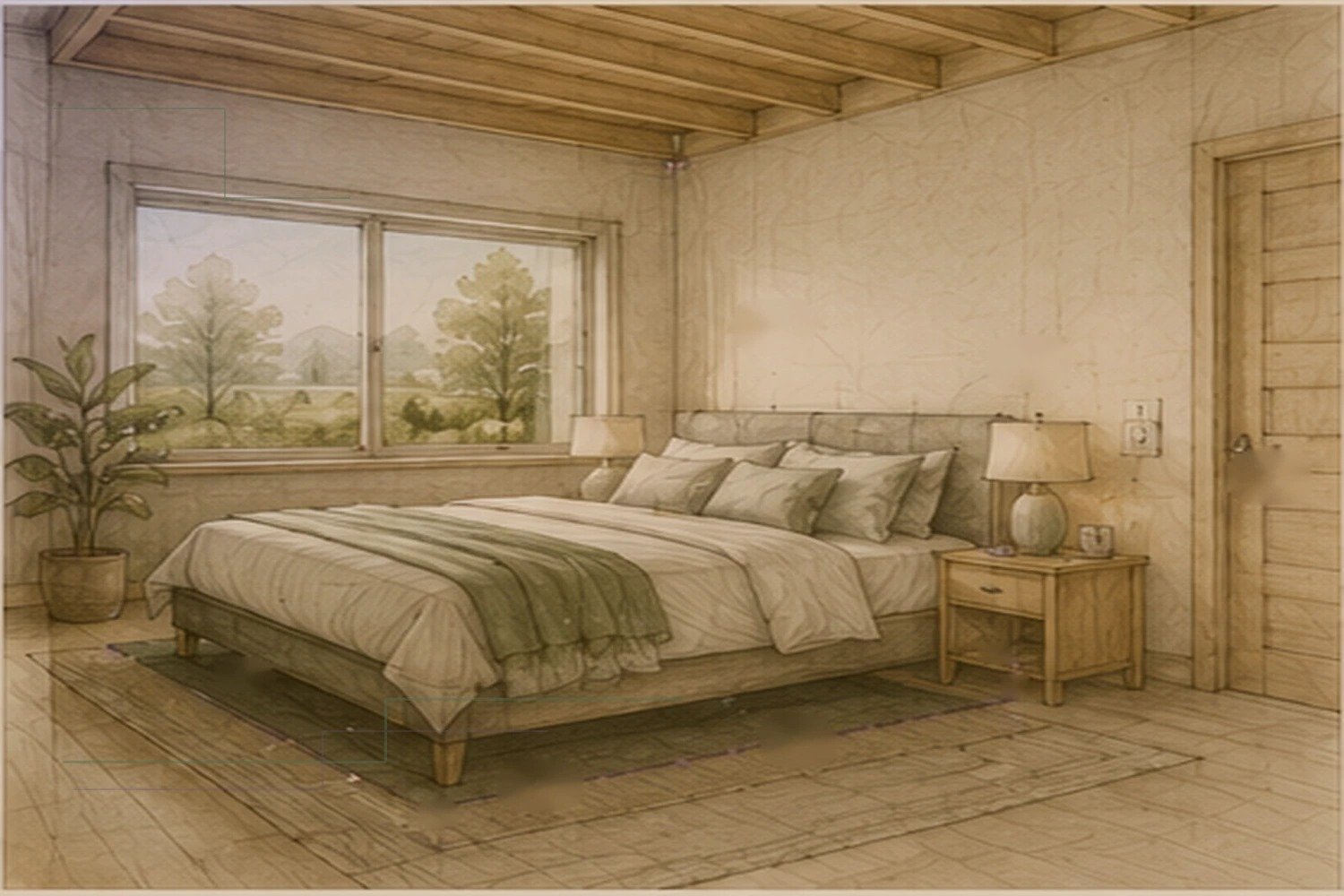
A modern luxury home can recognize when you arrive.
It can adjust temperature automatically.
Lower shades.
Change lighting scenes.
Arm security.
Play music.
Manage energy.
Respond to voice commands.
Yet one of the most important operating states in the house is often barely considered:
What should the home do when you sleep?
We think bedrooms should have a night mode.
Not simply a lighting scene.
A whole-room operating philosophy.
Bedrooms are different
Most spaces in a home are occupied intermittently.
Bedrooms are different.
A person may remain in essentially the same position for seven, eight or nine hours.
That makes the bedroom one of the most important spaces to consider when planning electrical and technology infrastructure.
The goal is not to remove electricity or create an austere environment.
It is to ask which systems actually need to be active overnight, and how the room can support rest while preserving convenience.
Start with the architecture
The easiest bedroom improvements happen before construction.
Where is the electrical service?
Where are the main panels?
Where do major feeders run?
Is there a mechanical room on the other side of the wall?
An elevator controller?
An AV rack?
A transformer?
A solar inverter?
Battery equipment?
Where will the bed actually sit?

Distance is one of the simplest design tools available.
If a major source can be placed somewhere else without compromising the project, that is often preferable to trying to manage it later.
This is why bedroom planning should begin on the floor plan, not after furniture arrives.
Then consider the electrical system
Electrical wiring naturally produces electric and magnetic fields when energized and carrying current.
Good residential design considers where wiring travels and how it relates to long-duration occupied positions.
Depending on the project’s goals, bedroom strategies may include:
thoughtful circuit routing,
appropriate separation from high-current wiring,
avoiding unnecessary electrical equipment near the bed,
careful grounding and bonding,
and, for clients who want it, switching strategies that allow selected bedroom circuits to be de-energized overnight.
Not every home requires every measure.
The appropriate level depends on the project, the client and what is practical.
The important point is that the choice exists.
Lighting should change after sunset
Night mode is also a lighting question.
Healthy evening lighting is not simply about choosing a warm color temperature.
The complete system matters.
Spectrum.
Intensity.
Fixture placement.
Dimming behaviour.
Flicker.
Drivers.
Control systems.
Electrical noise.
A beautifully specified fixture can perform poorly if paired with the wrong dimmer or driver.
For bedrooms, we prefer lighting that becomes progressively warmer and lower in intensity as evening advances, while maintaining stable electrical performance.
A bedroom should not feel like a commercial space at 10 p.m.
The technology should support the time of day.
Wireless should be intentional
Wi-Fi and Bluetooth are extraordinary technologies.
They also tend to become default communication methods simply because they are convenient.
A new build offers another option.
Install wired infrastructure first.
Provide Ethernet where televisions, desks, automation equipment and other fixed devices are likely to live.
Use hardwired controls where appropriate.
Design Wi-Fi coverage rather than merely maximizing it.
Select access-point locations carefully.
And give the homeowner a practical way to reduce or disable unnecessary wireless operation at night if that is part of their design intent.
The objective is not “no Wi-Fi.”
It is controlled wireless.
Strong where it is needed.
Reduced where it is not.
Connected devices deserve scrutiny
Modern bedrooms can contain a surprising number of radios.
Televisions.
Speakers.
Motorized shades.
Thermostats.
Wearables.
Sleep trackers.
Alarm clocks.
Smart beds.
Security devices.
Phones.
Tablets.
Lighting controls.
Some transmit continuously.
Some transmit periodically.
Some allow wireless functions to be disabled.
Some appear disabled in software while radios continue limited communication.
For projects with specific low-EMF goals, commissioning should confirm actual behaviour rather than relying entirely on menus and specifications.
That distinction becomes increasingly important as homes become more connected.
Night mode should be easy
A design fails if it requires a technically sophisticated homeowner to operate it every evening.
Good systems reduce friction.
Ideally, night mode is simple.
One command.
One keypad button.
One automation scene.
Potentially:
evening lighting shifts warmer,
unnecessary lights and loads shut down,
selected wireless access points reduce or stop operation,
bedroom circuits enter the chosen overnight state,
temperature adjusts,
shades close,
security changes mode,
and the home becomes quieter without losing essential functionality.

Then morning mode restores what is needed.
This is where thoughtful automation becomes extremely valuable.
Instead of adding more technology, automation can be used to make technology more restrained.
Verification closes the loop
Plans do not guarantee performance.
That is why important bedroom conditions should be checked after construction.
Is the wiring where the drawings say it is?
Are the selected wireless systems behaving correctly?
Do lighting systems remain stable through their dimming range?
Are the intended shutdown functions actually shutting down what they were meant to?
Did construction changes introduce something unexpected?
Measurement turns an intention into a verified condition.
The luxury of control
The goal of a night-mode bedroom is not to create fear around electricity or wireless technology.
It is to create control.
During the day, the home can be connected, responsive and powerful.
At night, systems that are unnecessary can become quieter.
The house adapts to the person rather than expecting the person to adapt to the house.
That is a subtle difference.
But in sophisticated residential design, subtle differences are often where the real quality lives.
A luxury home should know how to entertain.
How to illuminate.
How to secure itself.
How to conserve energy.
And increasingly, we believe it should also know how to become quiet.