
JournalSYSTEMS, NOT PRODUCTS
Why a Product List Is Not a Low-EMF Design Strategy
The first question is almost always which products to buy. It is the wrong first question.
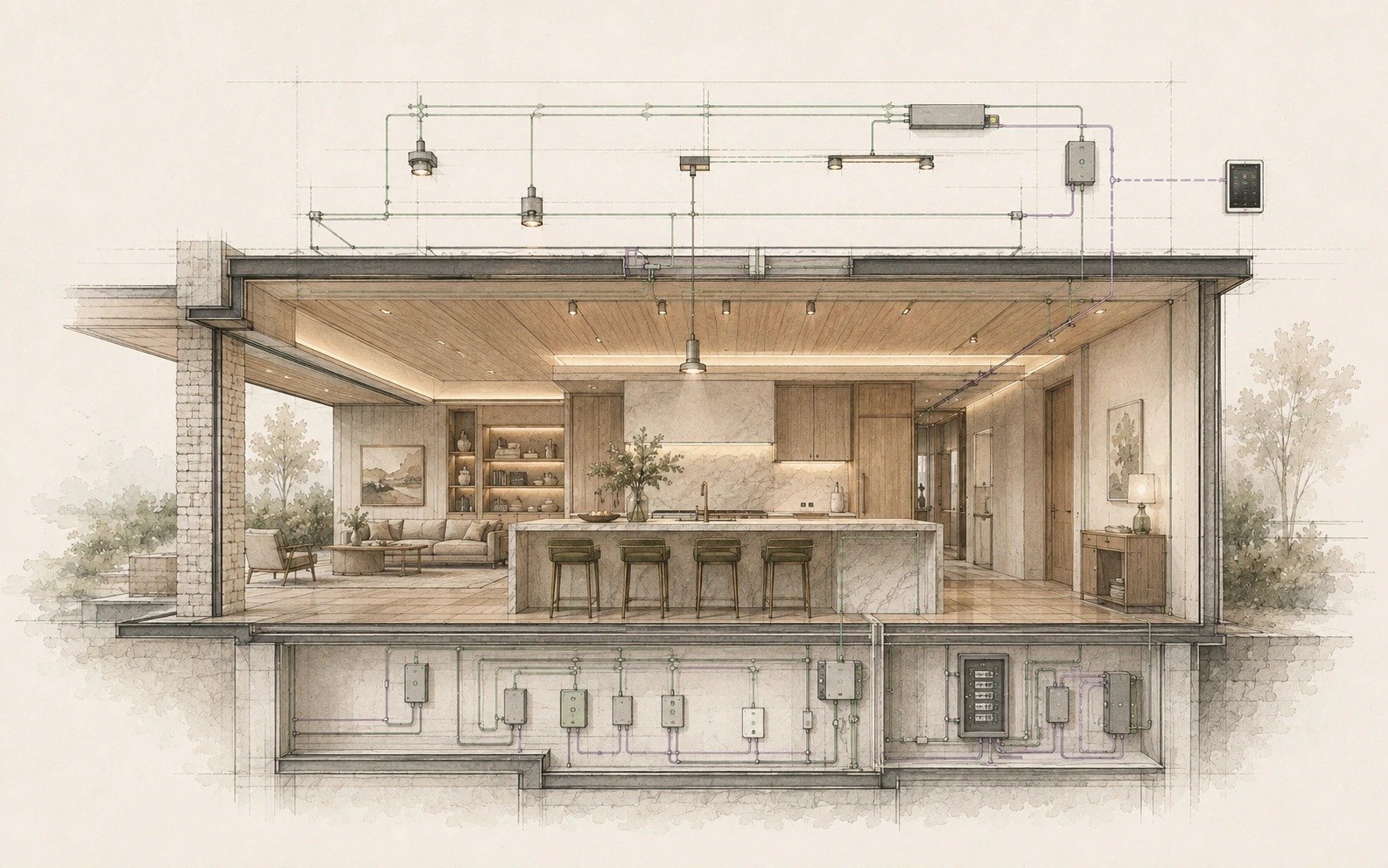
One of the first questions we are often asked is:
What products should we use?
Which lighting?
Which dimmer?
Which wire?
Which router?
Which shielding?
Which appliance?
Which solar inverter?
It is an understandable question.
Products are tangible. They can be compared, specified and purchased.
But after assessing more than a thousand homes and working through increasingly complex residential projects, one lesson becomes clear:
A low-EMF home cannot be designed from a shopping list.
Products do not operate in isolation
A product specification tells you something about the product.
It does not necessarily tell you what will happen when that product is installed in a specific house, beside specific rooms, connected to other equipment and operated in a particular way.
Lighting is a good example.
The same LED source can behave differently depending on the driver.
The same driver can behave differently with different dimmers.
Dimming performance can change as output level changes.
Flicker can vary with control method.
Electrical noise can depend on the entire combination.

The relevant unit is not always the bulb, fixture, driver or dimmer.
It may be the system.
The same is true elsewhere in the home.
A Wi-Fi access point that is completely appropriate in one location may be poorly located in another.
A solar inverter may be an excellent piece of equipment while still being installed too close to a repeatedly occupied position.
A connected appliance may offer a documented way to disable wireless, or may continue communicating differently than expected.
A cable marketed as shielded is only useful if the shielding strategy is understood and installed correctly.
There are very few universally “good” products.
There are appropriate products used in appropriate configurations.
The better question is: what are we trying to achieve?
Before selecting equipment, we establish the design intent.
What spaces matter most?
How will the family use the home?
What technology is important to them?
What level of wireless functionality do they want?
What needs to operate overnight?
Where will people sleep, work and spend long periods of time?
What systems are already fixed?
What can still be changed?
What are the realistic priorities for this particular project?
Those questions create criteria.
Criteria can then guide product selection.
Without them, purchasing decisions become disconnected from the result the client actually wants.
Sometimes the best product is no product
The traditional mitigation mindset often jumps quickly to materials and devices.
Our first questions are different.
Can the source be removed?
Can it be relocated?
Can more distance be created?
Can the wiring route change?
Can the equipment room move?
Can the communication method be changed?
Can an unnecessary transmitter be disabled?
Can nighttime operation be different from daytime operation?
Only after those opportunities are considered do specialty mitigation products enter the conversation.
This matters for luxury projects because the cleanest technical solution is often also the cleanest architectural solution.
You should not need to compromise a carefully designed room because a preventable infrastructure decision was made six months earlier.
Compatibility matters more than labels
One of the reasons we test equipment is that labels can be misleading.
“Low flicker.”
“Smart.”
“Shielded.”
“Hardwired.”
“Wireless disabled.”
“EMF reducing.”
Those phrases may tell us very little without context.
Low flicker at what dimming level?
Wireless disabled in software, or physically inactive at the radio?
Shielded with what termination method?
Hardwired for communication, while still containing an active wireless radio?
Quiet in one operating mode, but different under load?
We prefer measurable questions.
What is happening?
Where?
Under which operating condition?
At what distance?
Does it change when another component is added?
Does the configuration behave the way the team expects?
That is more useful than relying on marketing terminology.
A house is an ecosystem of systems
A modern custom residence may include:
electrical distribution, lighting, HVAC, building automation, AV, networking, surveillance, motorized shades, solar, batteries, generators, EV charging, appliances, pools, wellness equipment and more.

Every one of those systems may be designed by capable specialists.
Our role is not to replace them.
It is to look across the boundaries.
We ask what happens when those systems occupy the same building and interact around the same people.
That cross-system view is where many important decisions appear.
Products change. Principles last.
There is another problem with product lists.
They age quickly.
A recommended fixture is discontinued.
A manufacturer changes a driver.
A firmware update changes wireless behaviour.
A new model replaces the old one.
A supplier changes components.
A product available in Canada may not exist in California, Australia or Europe.
A design philosophy is more durable.
If the project understands the hierarchy,
eliminate, separate, organize, optimize, mitigate and verify,
then individual products can change without losing the intent of the design.
The team knows what the product needs to accomplish.
That is far more useful than a static list.
What we actually provide
We do make product recommendations.
We test equipment.
We review cut sheets.
We compare technologies.
We help select lighting, networking, electrical and other components when those choices materially affect the project.
But those recommendations come after the design intent is understood.
That distinction is fundamental.
A product is a tool.
The strategy is the system around it.
And the goal is not to build a house full of “low-EMF products.”
It is to create a home whose invisible infrastructure works together intelligently.